

New Scientific Study Raises Serious Questions About Hidden Toxicity in Fire-Damaged Homes
When most people think about fire damage, they picture burned materials, smoke odor, soot staining, and structural destruction. But according to a newly published 2025 study, the real danger may be what homeowners cannot see.
A recent peer-reviewed publication titled Industrial Hygiene Method for Assessing Toxic Contamination in Smoke and Fire-Damaged Homes by Phalen and Nieusma highlights growing concerns regarding toxic contamination that can remain in homes long after a fire appears to be “cleaned.”
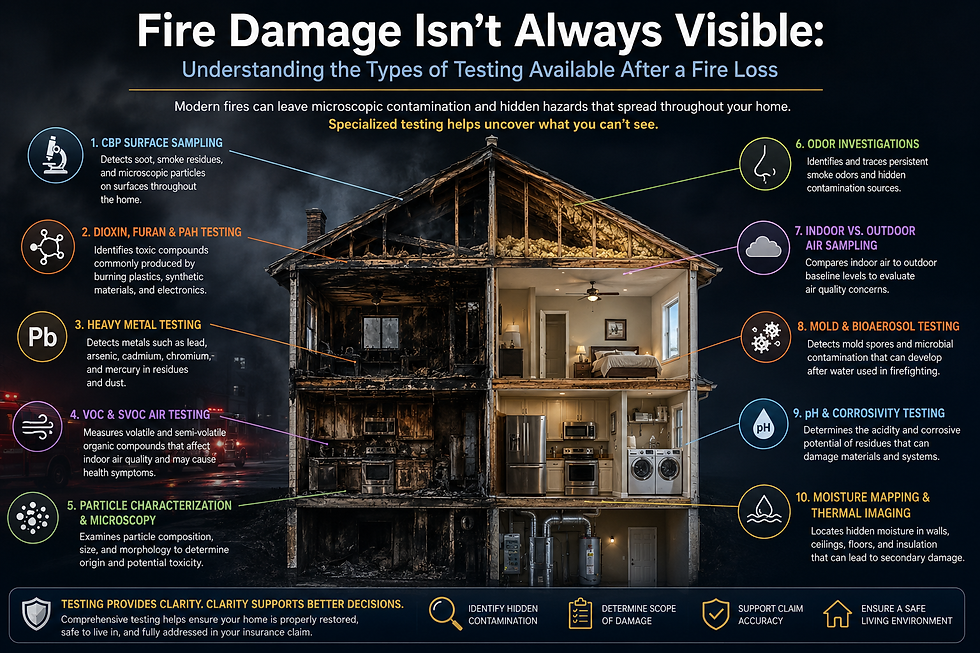
The study discusses how smoke and combustion byproducts may contain dangerous substances including:
Heavy metals
Polycyclic aromatic hydrocarbons (PAHs)
Dioxins
Furans
Lead
Arsenic
Cadmium
Chromium
According to the authors, these contaminants are often present in fire debris, char, and ash — but may also travel throughout the property through HVAC systems, air movement, and even water used during firefighting efforts.
Why This Matters for Homeowners
Many insurance claims focus primarily on visible damage:
Burned materials
Surface soot
Odor
Structural repairs
However, this emerging research suggests contamination may extend well beyond visibly affected areas.
Microscopic particles generated during combustion can settle into:
Insulation
HVAC systems
Soft contents
Porous building materials
Hidden cavities
Furniture and fabrics
In some cases, homeowners report ongoing irritation, respiratory symptoms, or persistent odors even after standard cleaning procedures have been completed.
The study argues that traditional visual inspections may not fully identify the extent of contamination inside a fire-damaged structure.
The Insurance Implications
This research may have significant implications for property insurance claims.
One of the most common disputes following a fire loss involves the scope of cleaning versus replacement. Insurance carriers often rely on standard remediation protocols that focus on visible residue and odor removal. But if contamination exists beyond what can be visually identified, homeowners may face incomplete restoration.
That creates difficult questions:
Was the home truly restored to a safe pre-loss condition?
Were proper environmental assessments performed?
Was testing limited or comprehensive?
Were contents appropriately evaluated?
Did remediation address hidden contamination pathways?
These issues are becoming increasingly important in wildfire claims, kitchen fires, electrical fires, and smoke-only losses where damage may appear minimal on the surface.
The Importance of Proper Evaluation
Every fire loss is different. The type of materials burned, duration of exposure, airflow patterns, HVAC operation, and suppression methods can all affect contamination spread.
In complex losses, industrial hygienists and environmental professionals may play a critical role in evaluating:
Air quality
Surface contamination
HVAC contamination
Combustion residues
Toxic exposure concerns
A thorough investigation can help determine whether cleaning, sealing, or replacement is the appropriate course of action.
What Homeowners Should Know
If your home has experienced fire or smoke damage, do not assume the absence of visible soot means the property is fully safe or properly restored.
Homeowners should consider:
Independent evaluation of the damage
Detailed documentation
Environmental testing when appropriate
Reviewing the full remediation scope
Understanding what was — and was not — included in the insurance estimate
Fire claims are often far more complex than they initially appear.
Final Thoughts
This new study adds to a growing body of discussion surrounding post-fire contamination and environmental safety inside damaged homes. As science continues to evolve, homeowners and property professionals alike may need to rethink how fire losses are investigated and restored.
The goal after a fire should not simply be making a property look clean — it should be ensuring the home is properly restored for the people living inside it.
Source
Phalen, D., & Nieusma, J. L. (2025). Industrial hygiene method for assessing toxic contamination in smoke and fire-damaged homes. Toxicology Mechanisms and Methods. DOI: 10.1080/15376516.2025.2561118


Comments